





Chains with round links: a description of the types and instructions for choosing
A chain is a flexible metal product assembled from links connected in series. Chains are used on ships and industrial enterprises, for the transport of logs and other goods, in the extraction of rocks and minerals. They are used to make interior decorations and compositions for creating landscape design.
Chains are divided into types according to purpose, tensile strength, type of metal, configuration, link size and a number of other characteristics. In the article we will tell you how to choose a chain for solving a specific problem.
general purpose
If the chain has normal strength, its links are made of low-carbon steel of class II, welded and have a caliber of 2-16 mm, it is considered a universal product for general use. The standards that regulate the production of such products are DIN 763, DIN 5685 Form C, DIN 766, DIN 5685 Form A.
General purpose chains are used for the manufacture of suspensions, stretch marks and other fastening devices designed for static loads. They are tied to livestock, as well as well buckets and swing seats, etc. If the links are long, the chain is more mobile, and if it is short, then it is more durable.
Cargo and traction, standard strength
These are all types of chains capable of withstanding a breaking load of up to 800 N/mm2. The standards that the products comply with are GOST 2319 or TU. Slings are assembled from them, used to complete lifts and other cargo special equipment. Cargo and traction chains fix large and heavy loads on tractors and ships. With the help of traction, they also move heavy objects.
Particularly strong load-bearing
This category includes chains made of high-alloyed hardened steel type T8 according to the standards DSTU EN 818-2: 2017, DIN 5687, GOST 30188-97, GOST 25996. They are designed for a load of more than 800 N / mm2. As blanks, manufacturers use a steel bar with a circular cross section. The thickness of the blanks is 4-32mm. The links of these chains are welded and deburred. After assembly, the products are hardened so that they can withstand heavy loads, receive a large margin of fatigue strength, and are not damaged during prolonged abrasive exposure.
Decorative design
Chains for interior and landscape design can be any - metal and non-metal, non-ferrous, imitating noble metals. They are used in the production of jewelry, tailoring, zoning of public areas.

Classification of chains by caliber and pitch
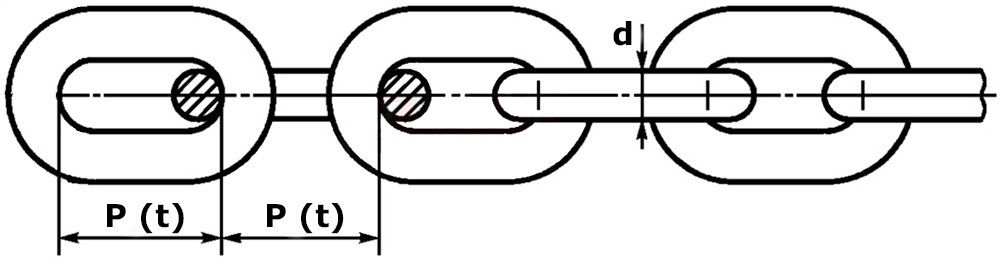
Chain pitch (P) is the length of the link, measured from the inside. For example, P = 12 mm.
Chain gauge - the diameter of the section of the bar from which the links are bent. This is the main characteristic, indicated by numbers: for example, 10 mm. Often, the caliber and pitch are indicated side by side through the letter X: 8x12 mm.
| Caliber, mm | Pitch, mm | Length 11 links, mm |
| 6 | 18.5 | 203.5 |
| 7 | 22 | 242 |
| 8 | 24 | 264 |
| 10 | 28 | 308 |
| 12 | 36 | 396 |
| 13 | 36 | 396 |
Types of welded chains with round links
Type A short link chains have a pitch to gauge ratio not exceeding 3.5. They don't get tangled when stored, but their links don't move as fast as long links. Short-link chains - withstand heavy loads, do not break when pulled at corners and tightly wrap around lifting hooks, so they do not allow the load to come off during movement.
Type B long link chains have a pitch to gauge ratio greater than 3.5. They are mobile, easy to build up and shorten. If you stretch one link through another, you get a loop. Long-link chains weigh less than short-link chains and are cheaper, because less metal is spent on the manufacture of one running meter.
Note! If the strength class of the chain is important - for example, you work with lifting equipment with blocks and drums - you should look for an option with short links. If mobility and light weight are the most important, it is better to choose a chain with long links. Before buying, check if the hook, carabiner or shackle can be slipped through the link of a particular chain.
Calibrated and uncalibrated chains
Calibrated chains of execution No. 1 are made from a round steel bar with exact geometric dimensions. They are calcined and stretched to find out the maximum deviations of the pitch and length of the test section. In the case of calibrated chains, it should not exceed + -3% of the dimensions established by the standards. They are used for the operation of conveyors, winches, bucket conveyors, cargo special equipment, various lifts.
Uncalibrated chains of execution No. 2 can be extended within + -10%. They are suitable for pulling on smooth drums and for use in mechanisms that are only subjected to static loading.

What to do if the chain sticks or slips on the sprocket block?
Buy a carefully calibrated chain with no more than 2.9% tolerance deviations. Test it under load. If the actual tolerance exceeds 2.9%, the chain will slip after the first few turns and will need to be replaced.
How to know the quality of the calibration?
Buy a short link chain meter and find out the length of eleven links for this chain. Pull the chain. Measure the length between the inside of the first link and the inside of the last. Use the table of measurement results for calibrated chains with short links.
How to find out the breaking strength of a chain?
Manufacturers indicate in the description of the chains the working, trial and breaking load.
The working load is the highest load a chain can withstand during use.
Proof load is double the working load or halve the breaking load. A trial load is given at the factory to verify the quality of the welding of the links.
The breaking or breaking load is the four working loads.
You can see these characteristics in the documents provided by the manufacturer.
| Caliber, d mm | Pitch, p mm | Width, b mm | Previous deviation section length l=11p | Load, kN | ||||
| nominal | prev.deviation | nominal | prev.deviation | nominal | prev.deviation | trial | destructive | |
| 5 | ±0.4 | 18.5 | ±0.5 | 17 | ±0.5 | 1 | 5 | 10 |
| 6 | 18.5 (19) | 20 (21) | ±0.6 | 7 | 14 | |||
| 7 | 22 | 23 | ±0.7 | 9 | 18 | |||
| 8 | 23 (24) | ±0.6 | 26 (27) | ±0.8 | 13 | 26 | ||
| 9 | ±0.5 | 27 | 32 | ±0.9 | 1.7 | 16 | 32 | |
| 9.5 | 27 | 31 | ±1.0 | 17 | 34 | |||
| 10 | 28 | 34 | ±1.1 | 20 | 40 | |||
| eleven | 31 | ±1.0 | 36 | ±1.3 | 23 | 46 | ||
| 13 | 36 | 44 (43) | ±1.6 | 2.5 | 33 | 66 | ||
| 16 | ±0.8 | 45 (44 | 53 (54) | ±1.8 | 51 | 102 | ||
| 18 | 50 | 60 | ±2.0 | 63 | 126 | |||
| 20 | 56 | ±1.5 | 67 | ±2.3 | 3.7 | 80 | 160 | |
| 23 | ±1.0 | 64 | 77 | ±2.6 | 100 | 200 | ||
| 26 | 73 | ±2.0 | 87 | - | - | 126 | 252 | |
| 28 | 78 | - | 94 | - | - | 150 | 300 | |
| thirty | 84 | - | 101 | - | - | 170 | 340 | |
| 33 | ±1.5 | 92 | - | 112 | - | - | 200 | 400 |
| 36 | 101 | - | 122 | - | - | 250 | 500 | |
| 39 | 109 | - | 132 | - | - | 280 | 560 | |
| 42 | 118 | - | 142 | - | - | 340 | 680 | |
How to determine the strength class?
The strength class is assigned depending on the mechanical characteristics of the chain - a number from 2 to 12. Products from 2 to 7 classes are called chains of normal strength, and from 8 to 12 classes are called high-strength chains.
Important . The stronger the chains, the higher their wear resistance, the less often they break when rubbing against sharp corners.
| Quality class | 2 | 2.5 | 3.5 | 5 | B | 7 | 8(S) | 10(D) |
| Test load stress, N/mm | 75-120 | 120 | 240 | 315 | 500 | 600 | 640 | 800 |
| Tension under breaking load, N/mm | 150-240 | 240 | 360 | 500 | 630 | 750 | 800 | 1000 |
Chain sizing for anti-theft protection
Bicycles and motorcycles are best protected from theft by high-strength hardened chains of T-8 strength. They are hard to straighten with a wrench, saw, bite or damage in some other way if there are no hydraulic shears or a diamond blade at hand. Household chains do not work as anti-theft. The same goes for products bought at a hardware store and old chains found in a basement or garage.
How to choose the length and gauge of the chain?
The length of the chain for fastening a bicycle or motorcycle is 0.6–1.2 m. The recommended diameter of the rod from which the links are bent is 8–13 mm, the diameter of the shackle at the lock should be the same. The thicker the chain, the more difficult it will be to steal the vehicle. If the shackle of the lock is thin, it will become a weak link and attract thieves in the first place. Locks of the right type are available at bicycle accessories stores.
